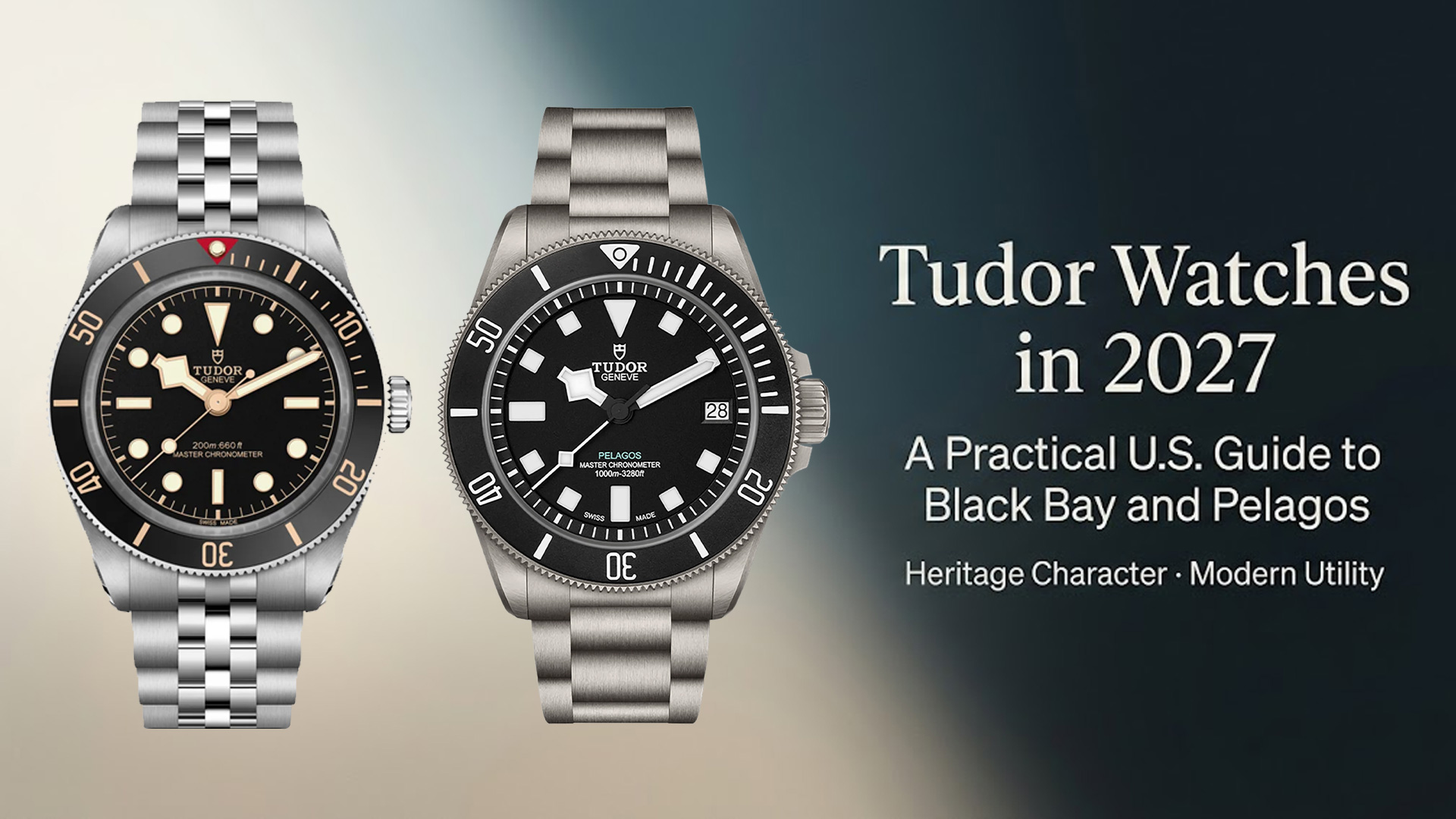
Tudor’s appeal is easier to understand by comparing the watches themselves: vintage-inspired Black Bay references and modern Pelagos tools.
A Tudor purchase should begin with a question: Black Bay or Pelagos?
Tudor makes some of its strongest arguments without relying on a grand story about the state of American luxury. Put a Black Bay beside a Pelagos and the difference is already clear. One often draws on mid-century diving cues; the other leans toward contemporary materials and practical tool-watch design. Both can be enjoyable, but the better purchase depends on which characteristics you actually want.
As 2027 approaches, Tudor remains worth considering for U.S. enthusiasts who care about case fit, movement specifications and what a watch is like to own after the initial excitement wears off. It is not necessary to label the brand a bargain Rolex or to promise future appreciation.
Black Bay: historical language, modern references
Black Bay has become Tudor’s best-known family, but it contains more than one watch. Case dimensions, bracelet options, bezels, date displays and movement specifications differ by reference. The snowflake hands and vintage-influenced appearance connect it to Tudor’s design history without making a modern Black Bay a vintage watch.
The Black Bay 58, for example, is associated with a more compact 39 mm format than some larger dive-style references. But even among Black Bay 58 variants, thickness, movement and clasp details can change. Choose the exact model before using a technical specification in a comparison.
The Pelagos alternative: material and purpose
Pelagos references appeal to buyers who prefer a technical appearance and practical dive-watch features. Certain models use titanium, helping the watch feel comparatively light for its dimensions. The Pelagos 39 is one example, while other Pelagos variants differ in size and equipment.
An enthusiast who spends most days in an office might still prefer Pelagos because of its lighter case and clean design. Someone attracted to historical styling may gravitate toward Black Bay. Neither collection belongs exclusively to divers, and a high water-resistance rating does not establish that a pre-owned example is ready for underwater use without suitable inspection.
What manufacture calibers and certification really mean
Tudor uses manufacture movements in many references, and selected models carry COSC chronometer certification. Some specific references also achieve METAS Master Chronometer certification. Those statements should not be generalized to every Tudor or every production generation.
For example, Tudor lists a Black Bay 58 variant with manufacture caliber MT5400-U and both COSC and METAS certification. Pelagos 39, by contrast, uses manufacture caliber MT5400 and has its own published testing and movement details. A buyer needs to verify the actual reference rather than assuming one movement label covers the entire brand.
Power reserve can make daily ownership more convenient, but it should not be treated as a measure of overall quality or present mechanical health. Even a well-specified movement can need servicing after years of use.
A good case fit matters more than reputation
The shape of the watch, its thickness and bracelet geometry all affect comfort. Try to assess how the first bracelet links bend around the wrist and where the clasp sits. If the model has an on-the-fly adjustment mechanism, make sure it operates smoothly and that enough links are present.
Do not rely entirely on dial diameter. Two 39 mm watches can wear differently because of lug shape, caseback thickness or strap configuration. This matters especially when buying remotely from a U.S. seller who cannot offer a conventional fitting.
What to inspect in a pre-owned Tudor
First, confirm the full reference and match the dial, hands, bezel, crown and bracelet to the correct model. Next, inspect for case damage, excessive refinishing and unusual bracelet wear. Check the bezel action and crown operation according to the manufacturer’s instructions. Ask for service documentation and establish whether any components were replaced.
Original papers are useful evidence of history but cannot establish every component’s current condition. Likewise, a watch-only Tudor is not necessarily a bad choice; it simply should not be priced or presented as though its original presentation set were complete. The practical U.S. pre-owned watch buying guide offers a broader checklist for comparing the condition and terms of secondhand listings.
Value is personal; resale is uncertain
Tudor can be attractive because a buyer values its design and engineering at the particular asking price. But ‘affordable luxury’ is relative, and no collector should assume a specific model will be easy to resell for a profit. Retail asking prices, completed sales, condition and seller fees are different variables.
A satisfying Tudor purchase is one you would still want if no one asked what it cost. Black Bay and Pelagos each provide a distinctive experience; the decision should be driven by fit, functions and a properly documented individual watch.
Frequently asked questions
Are all Tudor watches METAS certified?
No. Certification depends on the particular reference. Check the manufacturer’s specification for the exact model.
What is the difference between Black Bay and Pelagos?
Black Bay generally uses a more historically inspired design language, while Pelagos puts stronger emphasis on contemporary tool-watch construction. Exact features vary.
Is a Tudor without original papers a bad purchase?
Not automatically, but the absence of documentation increases the importance of careful reference and condition verification.
Should I buy Tudor as an investment?
A watch may retain some resale demand, but future prices and liquidity cannot be guaranteed. Buy for design, suitability and sound transaction terms.

