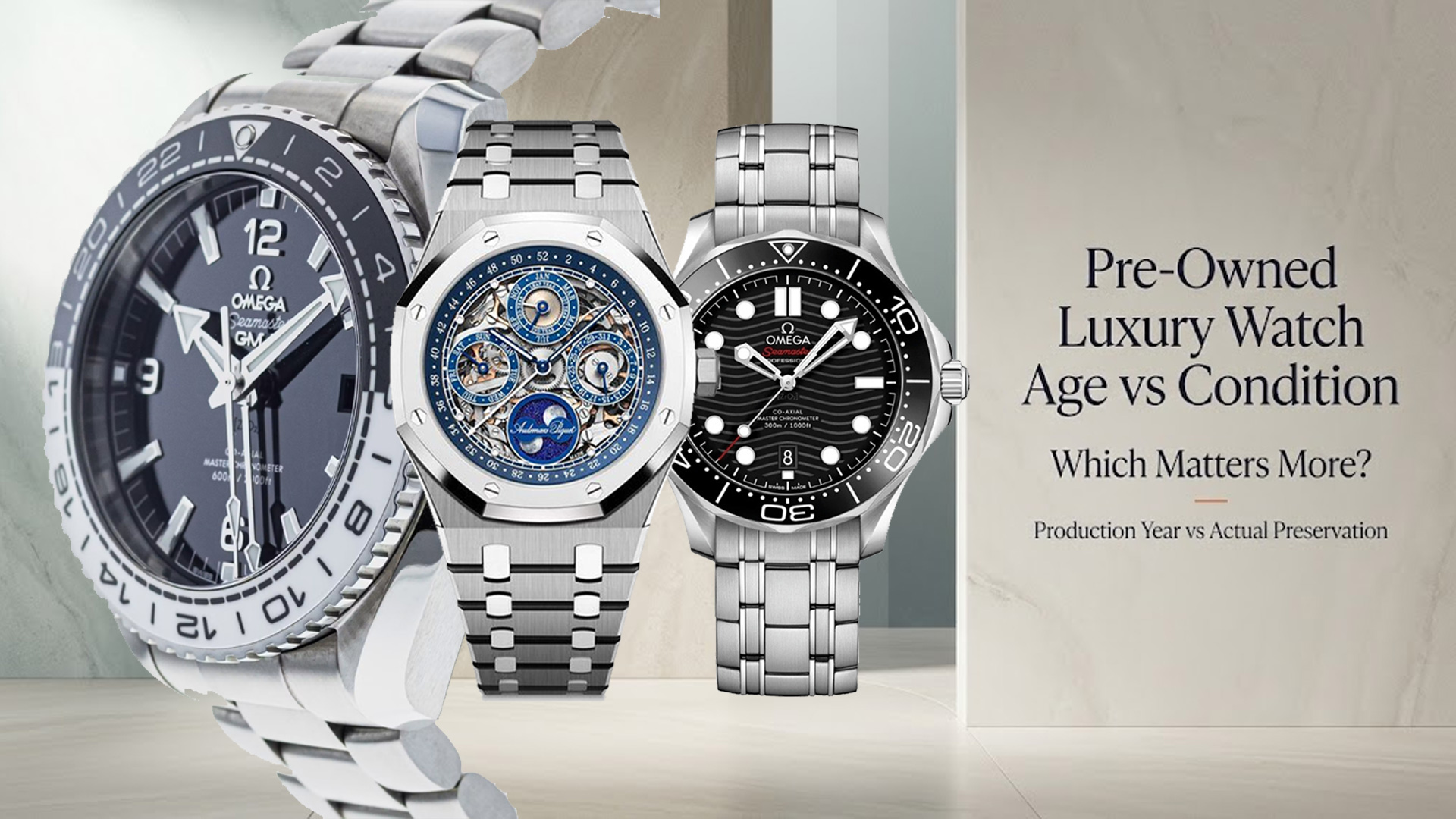
One watch is from 2024.
Another is from 2018.
Most buyers assume the 2024 example should be the safer purchase.
Sometimes it is.
Sometimes the six-year-older watch is better in almost every way that matters.
Age tells you when the watch belongs in its production history.
Condition tells you what happened to that individual watch.
When comparing pre-owned watch age vs condition, experienced buyers rarely treat the production year as an automatic quality score.
For most pre-owned luxury-watch purchases, condition usually matters more than age when the references are otherwise comparable. A newer watch can be heavily worn, polished or mechanically neglected, while an older watch may be exceptionally preserved and well maintained. Age still matters for generation, warranty status, movement updates, rarity and service context.
What Does Watch Age Actually Tell You?
Age may help establish:
- production generation;
- movement generation;
- design era;
- potential warranty position;
- historical context;
- approximate maintenance stage.
It does not tell you how the owner treated the watch.
Buyer insight: A newer date on the card does not erase hard wear on the case.
What Does Condition Tell You?
Condition should be broken into several separate dimensions.
Cosmetic condition
Scratches, dents, crystal wear, dial condition and visible marks.
Structural condition
Case geometry, bracelet integrity, crown, pushers and clasp.
Mechanical condition
Timekeeping, winding, date change and reference-specific functions.
Originality
Factory components, manufacturer service replacements and aftermarket modifications.
Service position
Known or unknown maintenance history.
A Two-Year-Old Watch Can Be Heavily Worn
Consider a newer sports watch worn every day.
It may show:
- deep clasp scratches;
- dented bezel;
- bracelet wear;
- poor polishing;
- water-related issues;
- unknown mechanical problems.
The calendar age tells you surprisingly little about those things.
An Older Watch Can Be Exceptionally Preserved
Another owner may have rotated a watch within a large collection and worn it occasionally.
A six-, ten- or fifteen-year-old example can therefore remain:
- sharp;
- complete;
- mechanically healthy;
- well documented.
When Age Does Matter More
Age becomes especially important when it changes the actual watch.
For example:
- new movement generation;
- case-size change;
- bracelet redesign;
- different power reserve;
- production discontinuation;
- new dial;
- material change.
At that point, you are not simply comparing newer vs older condition.
You are comparing different generations.
Rolex Generation Changes
A newer Rolex reference may include a different:
- movement;
- case size;
- bracelet architecture;
- bezel material;
The decision may therefore depend on which generation you prefer rather than which has the newer card.
Patek Philippe: Older Can Mean Discontinued
With Patek Philippe, an older watch may belong to a discontinued generation unavailable in current production.
That can increase collector relevance without guaranteeing that the older watch is financially “better.”
Audemars Piguet: Case Preservation Can Dominate the Decision
A newer Royal Oak with aggressive polishing can be less attractive to a condition-focused buyer than an older example retaining sharper geometry.
The architecture and integrated bracelet make physical condition especially important.
Richard Mille: Service and Case Material Matter
On a highly technical Richard Mille, age should be considered alongside:
- reference production status;
- case material;
- movement complexity;
- service history;
- strap condition.
Does Newer Mean Less Likely to Need Service?
Potentially, but not automatically.
A newer watch may have fewer years of mechanical operation.
But use conditions differ.
An older watch with documented maintenance may present less uncertainty than a newer watch with no useful history and poor performance.
Warranty Can Favour the Newer Watch
If transferable manufacturer coverage remains valid and applicable, a newer watch may have a practical advantage.
Confirm:
- actual warranty status;
- warranty start date;
- terms;
- whether modifications affect coverage.
Do not assume every newer pre-owned watch still has manufacturer coverage.
Box and Papers Can Correlate With Age—but Do Not Define Quality
Newer watches may be more likely to retain:
- original card;
- box;
- manuals;
That can make the set more complete.
It still does not make a poor-condition watch strong.
Vintage Is a Different Conversation
Once a watch becomes meaningfully vintage, age may become part of the reason it is desirable.
Then buyers may value:
- period-correct dial;
- patina;
- historical case;
- rare configuration;
- original components.
A vintage watch should not be graded by the same expectation as a two-year-old modern watch.
Patina vs Damage
Age-related change is not automatically attractive patina.
Distinguish desirable natural ageing from:
- moisture damage;
- corrosion;
- poor refinishing;
- dial restoration;
- structural deterioration.
Year Is Often Easier to Sell Than Condition
“2023 watch” fits neatly into a listing.
Condition requires explanation.
This can cause buyers to overweight age simply because it is an easy number.
Do not let an easy metric replace a harder but more important inspection.
Compare the Same Reference First
The cleanest age-vs-condition comparison is between the same reference.
| Factor | Watch A | Watch B |
| Reference | Same | Same |
| Year | Newer | Older |
| Case | Assess | Assess |
| Polishing | Assess | Assess |
| Mechanical | Assess | Assess |
| Service | Assess | Assess |
| Completeness | Assess | Assess |
What If the Newer Watch Is More Expensive?
Ask what the premium buys.
Possibilities include:
- remaining warranty;
- newer generation;
- better condition;
- stronger completeness;
- simply a newer production year.
If the only advantage is the date, decide whether that matters enough to you.
What If the Older Watch Is Cheaper?
Do not assume the price difference is automatically a bargain.
Check:
- service position;
- bracelet;
- case;
- movement;
- documents;
- reference generation.
Should You Pay More for an Older Unpolished Example?
Possibly, if the reference attracts condition-focused collectors and the preservation is genuinely exceptional.
But “older + unpolished” should not automatically justify any asking price.
A Practical Priority Order
For two comparable modern pre-owned watches, consider:
- Authenticity
- Correct configuration
- Structural condition
- Mechanical condition
- Wrist preference
- Service position
- Completeness
- Age/year
- Price
The order may change for vintage or highly collectible references.
Why Platinum Times USA Is Useful for Age-vs-Condition Buyers
Platinum Times Company USA carries pre-owned watches across multiple brands, conditions and generations.
That makes the Platinum Times inventory useful for buyers who want to compare the actual watch rather than automatically choosing the newest example.
The company currently operates from Laredo, Texas as part of a wider international pre-owned luxury-watch business.
Frequently Asked Questions
Is a newer pre-owned luxury watch always better?
No. Newer age can help with warranty or generation, but physical and mechanical condition may be more important.
Does watch age affect value?
Yes, particularly when it changes generation, rarity, production status or collector significance. Age alone does not determine value.
Should I buy an older watch in better condition?
Often that can make sense when the watches are otherwise comparable, but service history, configuration and price should also be considered.
Is an older Rolex worse than a newer Rolex?
No. Different Rolex generations can have different movements, proportions and collector appeal. The exact reference matters.
Does a newer watch need less maintenance?
Possibly, but current mechanical condition and actual use history matter more than age alone.
Is vintage condition graded differently?
Yes. Buyers may accept age-related wear and patina that would be undesirable on a recent watch, while still distinguishing genuine ageing from damage.
Can Platinum Times help me compare different production years?
Buyers can review current inventory and discuss individual reference and condition details with the Platinum Times team.
Final Considerations
Age tells you when the watch was made.
Condition tells you how that individual watch has lived.
For comparable modern references, the second question is often more important.
Do not pay a premium simply because one warranty card has a newer date. Pay for the watch whose generation, preservation, mechanical position and price make the strongest overall case.
Compare Pre-Owned Watches by Condition With Platinum Times USA
Browse the current Platinum Times luxury-watch inventory and compare references across different years, conditions and configurations.
If you are replacing an older watch with a newer generation—or the other way around—use the Platinum Times Sell/Trade service to evaluate your current piece as part of the upgrade decision.

