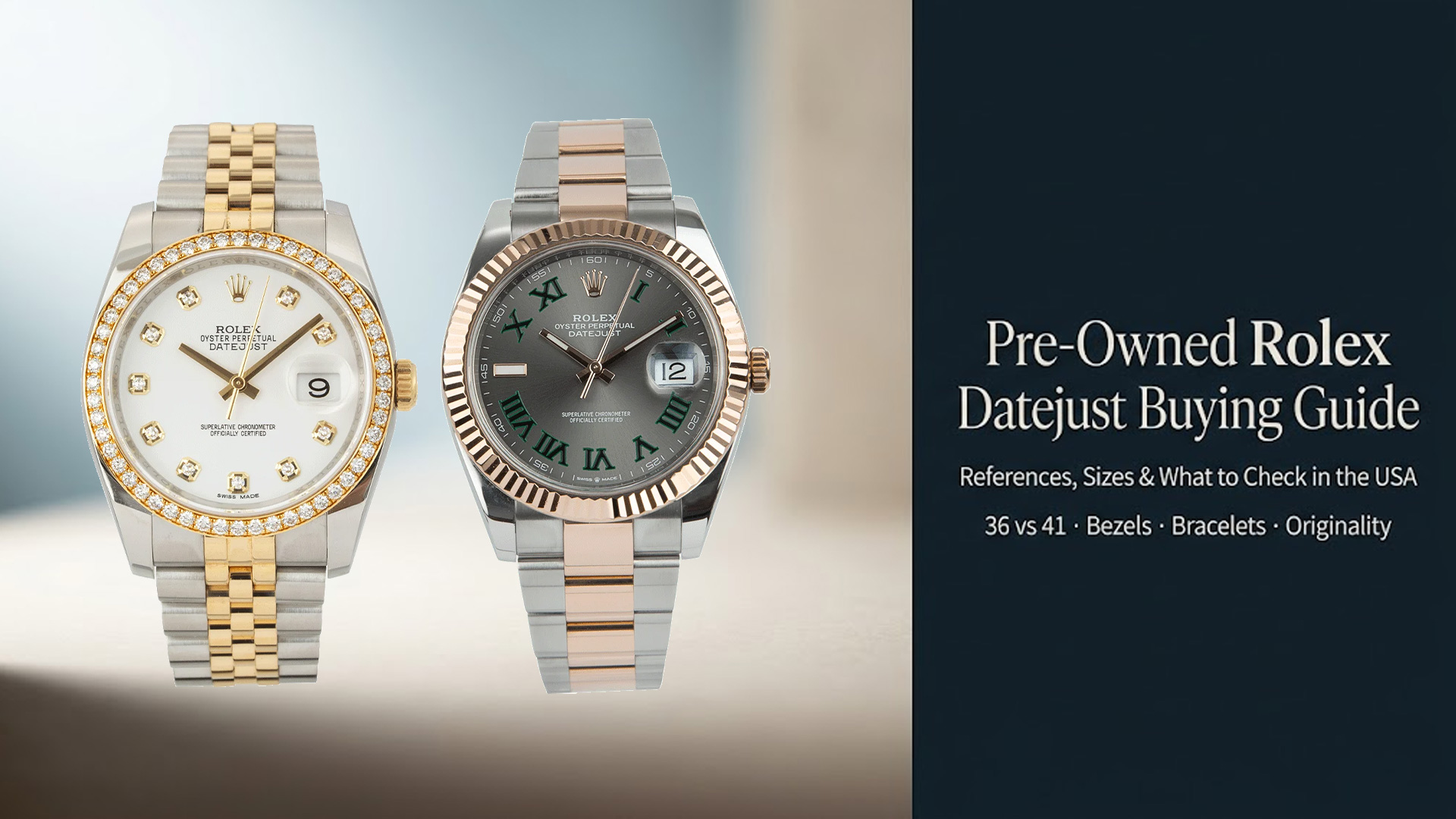
The Datejust looks simple from across the room. Up close, the size, the bezel, the bracelet and the generation are what decide whether you end up with the right one.
Few watches get described as “the obvious choice” as often as the Rolex Datejust. It is the Rolex people picture when they hear the word. It goes with a suit, a polo shirt and a Saturday at the lake equally well, and it has been in production in one form or another since 1945.
That familiarity is exactly what trips buyers up.
Because the Datejust has been made for so long, in so many sizes, metals, bezels, dials and bracelets, two listings that both say “Rolex Datejust” can describe watches that feel nothing alike on the wrist and have very little in common mechanically. A 36mm five-digit reference from the 1990s and a 41mm watch from the current generation share a name and a silhouette. Almost everything else is different.
This guide is written for U.S. buyers who are shopping the pre-owned market and want to make one decision well instead of five decisions by accident. If you already know what you want, you can browse the current pre-owned Rolex listings and come back to the inspection checklist further down.
What Makes a Datejust a Datejust?
Strip away the variations and every Datejust shares a few traits: a round Oyster case, a self-winding movement, a date window at three o’clock under the magnifying Cyclops lens, and a design meant to work every day rather than in one specialized setting.
Rolex introduced the Datejust in 1945 as a self-winding chronometer wristwatch with a date shown in a window, and the Jubilee bracelet was created for it at the same time. The Cyclops lens arrived in the early 1950s. Those three elements are still the core of the watch today.
Everything else is a choice. And those choices are where pre-owned buyers either find the perfect watch or end up quietly wishing they had bought the other one.
Datejust 36 vs Datejust 41: The First Decision
Size is the decision that matters most, and photos are terrible at helping you make it. A 41mm watch on a white background looks barely bigger than a 36mm one. On a wrist, the difference is obvious within seconds.
Datejust 36
Thirty-six millimeters is the classic Datejust size, and it is the one many longtime Rolex owners still prefer. It sits neatly under a shirt cuff, it feels balanced on a wide range of wrists, and it carries the proportions the watch was designed around. If you like a watch that reads as refined rather than prominent, start here.
Datejust 41
The 41mm Datejust has more wrist presence. The dial is bigger, the hands are longer, and the watch looks more contemporary. People who are used to modern sports watches often find 36mm feels small at first, and the 41 bridges that gap without turning the Datejust into something it isn’t.
What about the Datejust II?
Between roughly 2009 and 2016, Rolex sold a 41mm model called the Datejust II, with references such as 116300 and 116334. It is not the same watch as today’s Datejust 41. The Datejust II had a broader bezel and chunkier lugs, which made it wear larger and bolder. The later 41mm references slimmed the bezel and lugs back toward classic Datejust proportions and introduced a newer movement. Neither is wrong. They are simply different watches, and a listing that blurs them together is a listing you should ask questions about.
Smaller sizes
Rolex also makes the Datejust in 31mm and the Lady-Datejust in 28mm. These deserve their own discussion because sizing, dial options and gem-setting work differently at that scale. For this guide, the focus stays on 36 and 41, where most of the size debate happens.
The honest advice is to try both if you can. If you can’t, measure a watch you already own and like the fit of, then compare. Reading a case diameter off a spec sheet tells you surprisingly little about how a watch will actually feel.
Understanding Datejust Generations
The reference number tells you which generation you are looking at, and the generation affects the movement, the crystal, the proportions and how you should think about service.
| Era (approximate) | Example references | What to know |
| Vintage, four-digit | 1601, 1603 | Acrylic crystal, older movements and period-correct parts. Originality and service history matter more than anything else. A different buying exercise from the modern watches. |
| Five-digit, late 1980s to mid-2000s | 16200, 16220, 16233, 16234 | Sapphire crystal, calibre 3135 movement in this generation, slimmer bracelets and a lighter, more traditional feel on the wrist. |
| Six-digit, mid-2000s to late 2010s | 116200, 116234, 116233 | Updated case and bracelet with solid end links. Calibre 3135 continues in the 36mm models. |
| Datejust II | 116300, 116334 | 41mm with a broader bezel and lugs. Calibre 3136. |
| Current generation | 126200, 126234 (36mm); 126300, 126334 (41mm) | Calibre 3235 with a power reserve of about 70 hours. Updated case proportions. Eligible for Rolex’s five-year international guarantee when purchased new from authorized retail. |
One practical point stands out. Calibre 3235’s power reserve of around 70 hours means a current-generation Datejust taken off on Friday evening will usually still be running on Monday morning. Older movements with a shorter reserve generally won’t be. That isn’t a dealbreaker, since an automatic watch is easy to wind and set, but people who rotate between a few watches often notice the difference.
Rolex reference numbers also carry clues about the materials. In the current lineup, for example, a reference ending in 00 typically indicates a steel watch with a smooth steel bezel, while 34 indicates steel with a white gold fluted bezel. Use that as a way to sanity-check a listing, and always confirm against the watch itself and its documents rather than relying on the number alone.
Fluted or Smooth Bezel?
This is the most visible style decision on a Datejust, and it changes the personality of the watch more than people expect.
The fluted bezel is the one most people recognize instantly. On Datejust models it is made of gold, which is why steel watches with fluted bezels are known as Rolesor, Rolex’s term for its combination of steel and gold. A white gold fluted bezel on a steel watch catches light constantly, and it reads as dressier and more traditional.
The smooth bezel is quieter and more modern. It leans toward understatement and pairs well with casual clothes. It also tends to hide small marks a bit more gracefully than the sharp edges of a fluted bezel, which can soften with years of wear and heavy polishing.
For fashion-focused buyers, the bezel is usually the deciding factor in whether a Datejust feels like “you.” For buyers who care most about originality, the fluted bezel is also something to inspect closely, because worn or overly polished flutes are one of the clearest signs of a hard life.
Oyster or Jubilee Bracelet?
The Jubilee bracelet, with its five-piece links, is the original Datejust bracelet. It drapes, it shines, and it gives the watch a softer, more jewelry-like character. The Oyster bracelet, with its broad three-piece links, looks sportier and more robust.
On the current generation, the two bracelets also use different clasps, and the Oyster version typically includes Rolex’s Easylink comfort extension for small on-the-go size adjustments. Clasp details vary by generation, so check the specific watch rather than assuming.
On older pre-owned examples, the bracelet deserves as much attention as the case. Older Jubilee bracelets in particular can stretch over decades of wear, and a heavily stretched bracelet changes both how the watch looks and how it feels. Ask how many links are included, too. A watch sized for a smaller wrist with missing links can turn a good purchase into a frustrating one.
Dial Choice: Where Personal Taste Takes Over
The Datejust has one of the widest dial catalogs in the Rolex lineup: silver, blue, black, slate, champagne, green, and more, with stick markers, Roman numerals or diamond markers. The slate dial with green Roman numerals, often called “Wimbledon,” is a favorite. Brighter colors like mint green have also found an audience in recent years.
There is no objectively best dial. There is only the one you will still enjoy looking at in five years.
A few practical thoughts help, though:
- Neutral dials such as silver, black, blue and slate tend to be the easiest to wear with everything.
- Bold colors make a strong first impression. Decide whether you love the color or just love the photo of it.
- Diamond dials can look spectacular, but this is where originality checks become non-negotiable. More on that below.
Factory Diamonds vs Aftermarket Diamonds
This is the single most important warning in any Datejust guide.
Datejusts are among the most frequently customized watches in the world. Diamond bezels, diamond dials, and diamond-set cases and bracelets are widely added after the watch leaves Rolex. Some aftermarket work is skillful. Some isn’t. Either way, it is not factory original, and the difference matters for authenticity questions, for servicing with Rolex, and for resale.
Before buying any gem-set Datejust, ask directly whether the diamonds are factory Rolex or aftermarket. The reference number should match the configuration you are looking at. Documentation helps. If the seller cannot answer clearly, treat that as your answer.
Our guide to factory original versus aftermarket luxury watches goes deeper on how to tell the difference and why it matters long after the purchase.
What to Check Before Buying a Pre-Owned Datejust
Once you have narrowed down the size, bezel and bracelet, the work shifts from choosing a model to judging an individual watch. Two Datejusts with the same reference can deserve very different prices.
- Reference and serial details
Confirm that the full reference matches the case material, bezel, dial and bracelet. On modern Rolex watches, the serial number is engraved on the inner bezel ring at six o’clock. If papers are included, they should match the watch.
- Case and bezel condition
Look at the lug edges and case sides in good light. Sharp, defined surfaces suggest light polishing or none at all. Rounded, soft edges suggest repeated refinishing. If you’re unsure how much that should matter to you, our guide to polished versus unpolished luxury watches explains the trade-off.
- Bracelet and clasp
Check for stretch, loose links, clasp wear and the number of links included. A worn clasp is easy to overlook in photos and impossible to ignore once it’s on your wrist every day.
- Dial and hands
Look for spotting, uneven lume, misaligned markers or anything that suggests a replacement or refinished dial. The date should change cleanly and line up with the window.
- Mechanical performance and service
Ask about timekeeping and any known service history. A documented service isn’t automatically better than an honest “unknown,” but it removes a question mark. Our guide to why service history matters on a used luxury watch covers what records are worth asking for.
- Box, papers and completeness
A full set adds confidence and can help with resale later, but a watch-only Datejust in excellent condition can still be a strong purchase if the price reflects what’s missing. See full set versus watch only for how completeness tends to affect value.
Which Datejust Makes Sense for You?
Different buyers arrive at the Datejust for different reasons, and the “right” configuration changes with them.
If this is your first luxury watch, a current-generation or six-digit Datejust 36 or 41 in steel, on an Oyster or Jubilee bracelet with a neutral dial, is about as low-risk as a Rolex purchase gets. It is versatile, easy to wear and easy to understand.
If you care most about style, let the bezel and dial lead. A white gold fluted bezel with a Jubilee bracelet is the most classic look. A smooth bezel with a colored dial on an Oyster bracelet feels younger and more relaxed.
If you’re buying it as a gift, size is the riskiest assumption. When you can’t confirm wrist size discreetly, 36mm is generally the more forgiving choice. Also keep in mind that Platinum Times’ return and refund policy currently treats sales as final, so confirm size, dial and bracelet preferences before buying rather than after.
If you wear a watch to work every day, a Datejust 41 with a smooth bezel and an Oyster bracelet is hard to beat for comfort and durability. A Datejust 36 Jubilee looks sharper with formal clothes.
If you think about long-term value, keep expectations grounded. Steel Datejusts have historically been among the more liquid Rolex models on the secondary market, but no watch is guaranteed to hold or gain value. Condition, originality and completeness matter more than the badge. For context, read how luxury watch values change over time.
Buying a Pre-Owned Datejust From Platinum Times
Platinum Times Company is an independent pre-owned luxury-watch business with its U.S. location in Laredo, Texas. It is not an authorized Rolex retailer, and it isn’t affiliated with Rolex. What it offers is a secondary-market inventory that can include several Datejust generations and configurations at once, which makes direct comparison much easier.
If a specific reference catches your eye, ask the team for additional photos of the bezel, case sides, clasp and caseback, and confirm what documentation is included. Domestic orders ship fully insured under the current shipping policy, and you can reach the team through the contact page with any questions before you commit.
Thinking of upgrading from another watch? The Sell/Trade form lets you submit your current piece so a trade can be discussed alongside the purchase.
Frequently Asked Questions
Is a pre-owned Rolex Datejust a good first luxury watch?
For many buyers, yes. It is versatile, widely recognized, comfortable for daily wear and available in enough sizes and styles to suit most tastes. The key is choosing the right size and buying an example whose condition and originality are clearly documented.
Should I choose the Datejust 36 or the Datejust 41?
The 36 offers classic proportions and fits neatly under a cuff. The 41 has more wrist presence and a more contemporary look. Try both if you can, or compare against a watch you already own, because the difference is easier to feel than to read about.
What is the difference between the Datejust II and the Datejust 41?
Both measure 41mm, but the Datejust II has a broader bezel and chunkier lugs, while the later Datejust 41 references return to slimmer, more traditional proportions and use the newer calibre 3235 movement.
Are diamond Datejusts always factory original?
No. Aftermarket diamond bezels and dials are common on the Datejust. Confirm whether the diamonds are factory Rolex, check that the reference matches the configuration, and ask for documentation.
Does the Jubilee bracelet stretch over time?
Older Jubilee bracelets can show stretch after years of wear. Modern bracelets are built more robustly, but any pre-owned bracelet should be checked for looseness, clasp wear and the number of included links.
Does a pre-owned Datejust come with a Rolex warranty?
It depends on the watch’s age and original purchase date. Watches purchased new from authorized retail since 2015 carry Rolex’s five-year international guarantee from the original purchase date. Confirm the documented date rather than assuming coverage remains.
Can I trade in my current watch toward a Datejust?
Yes, a trade can be discussed with Platinum Times. Submit your watch’s details and photos through the Sell/Trade form to start the conversation.
Final Thoughts: Choose the Watch, Not Just the Name
The Datejust’s reputation is earned, but the name alone doesn’t tell you which Datejust you’re buying. Decide on size first, then bezel and bracelet. After that, let the condition of the individual watch, its originality and its documentation decide whether the price makes sense.
Get those decisions right and the Datejust becomes what it has been for generations of owners: the watch you reach for without thinking about it.
When you’re ready, explore available pre-owned Rolex references, or contact the Platinum Times team to ask about a specific Datejust.

