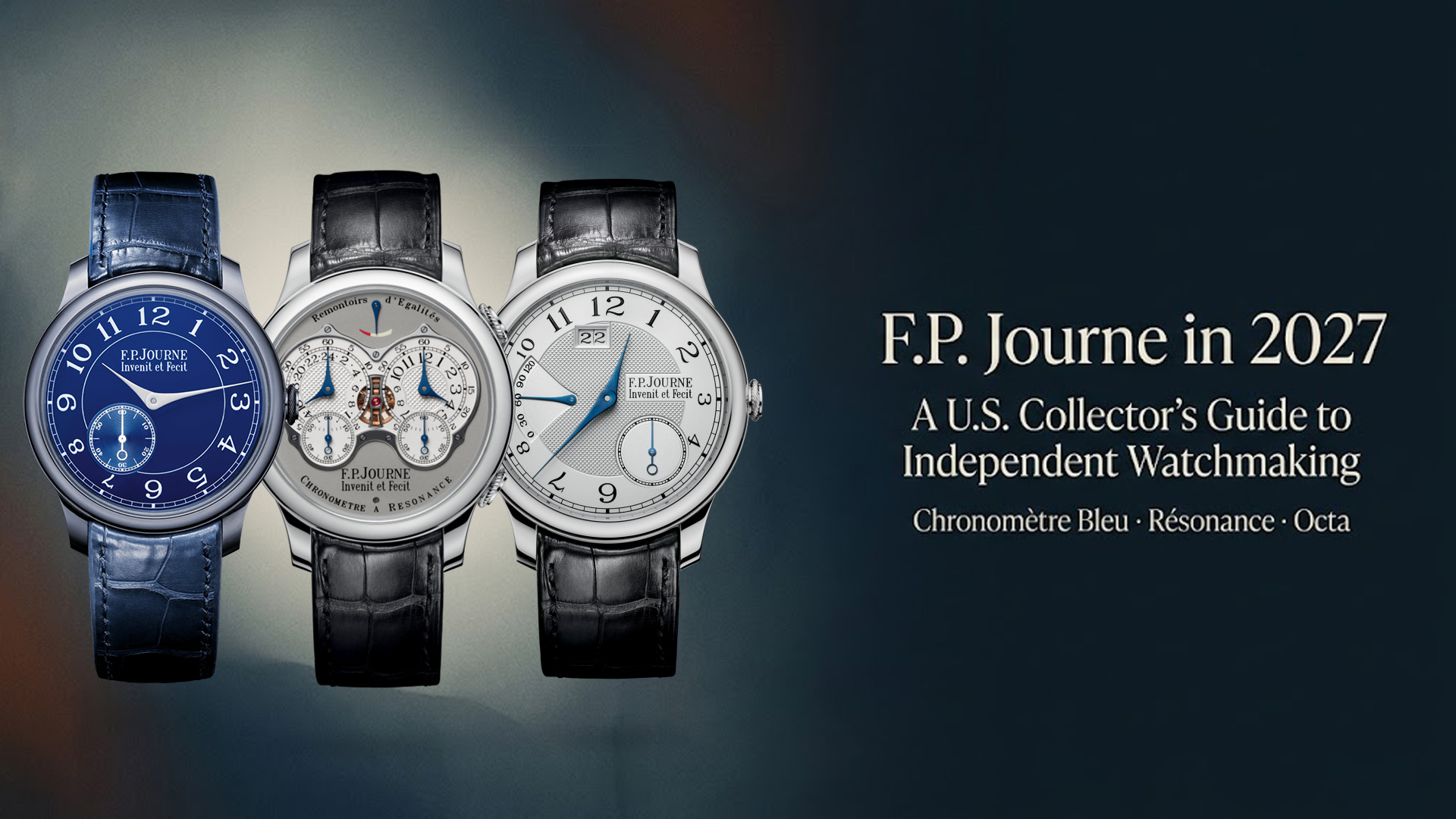
A collector’s interest in F.P. Journe makes the most sense when design, movement construction and the history of an individual reference are considered together.
Independent watchmaking becomes interesting when you look closely
F.P. Journe is a name that often enters the conversation after a collector has spent time learning how mechanical watches work. The attraction is not simply that the watches are difficult to find or expensive to buy. It is that François-Paul Journe’s design language and movement architecture are unusually recognizable, from asymmetric dial arrangements to approaches to chronometry that reward real curiosity.
As 2027 approaches, U.S. buyers considering the brand should approach it with the same questions they would ask of any significant pre-owned watch: Which reference is this? Which production generation? What is original? What does the maintenance record support? The answers matter more than a sweeping claim that all Journe watches are ‘rare.’
Chronomètre Bleu: simplicity that is not simple
The Chronomètre Bleu can look understated at first. Its distinctive dial and relatively clean display conceal serious attention to materials and movement construction. The model is associated with a tantalum case and a richly colored blue dial, details that make it different from the usual precious-metal dress watch.
It is easy to admire that appearance in photographs; it is harder to assess a pre-owned example without examining the dial surface, case edges and actual reference details. Any claim about production scarcity, investment performance or condition should be supported rather than inferred from the model’s reputation.
Résonance: the idea that makes a collector stop and think
The Chronomètre à Résonance explores a demanding mechanical idea: the interaction of two regulating systems within one watch. It is a defining part of Journe’s identity because it invites the wearer to think about the regulation of time itself rather than treating movement decoration as the whole story.
This is not a complication to evaluate from a static dial photograph. Functions, caliber version and service history must be understood for the precise reference. Buyers should seek qualified technical assessment when the mechanism’s behavior is uncertain. A watch that appears to run correctly during a brief viewing may still need specialist maintenance.
The Octa family brings a different kind of practicality
The Octa collection demonstrates how an independent watchmaker can pursue daily-wear convenience without abandoning a distinctive mechanical point of view. Depending on reference, Octa watches can include automatic winding alongside calendar, power-reserve, moon-phase or other indications. The exact functions vary considerably across the family.
That is why generic descriptions can be misleading. ‘Octa’ does not tell you which indicators are present, which movement version is fitted or whether a particular control is operating correctly. Check the full model designation, then obtain the correct operating guidance before using unfamiliar calendar functions.
Materials and movements: avoid one-size-fits-all claims
F.P. Journe is well known for movement construction involving 18-karat rose gold in many models and periods, but that fact should not be carelessly attached to every historical watch. Early production, later generations and individual complications require reference-specific research.
Case metal is another point of distinction. A tantalum Chronomètre Bleu cannot be assessed as though it were a conventional polished-gold dress watch. The materials, dial and finishing all influence condition checks. Original buckles, straps, certificates and related components may be particularly important to a buyer who values completeness.
Buying in the U.S.: knowledge matters more than status
A practical pre-owned assessment includes the movement number and relevant documentation where available, service history, dial and hand originality, case condition, and the integrity of any complications. The seller should state clearly if components have been replaced. If a certificate or archival record exists, establish exactly what it proves; it is not a mechanical health guarantee.
Watch values can fluctuate and the market for a particular independent reference may be less liquid than buyers expect. Asking prices are not confirmed transaction prices, and no purchase should rest solely on an expectation of appreciation. When available, comparing F.P. Journe references in the Platinum Times Co. catalog can help readers identify specific models to research, not substitute for an individual inspection.
What gives Journe lasting appeal?
The strongest answer is the watchmaking itself. These watches have a coherent point of view, and owners can enjoy learning why an asymmetric dial or unusual movement architecture was chosen. That experience is genuinely different from buying an object primarily for easy brand recognition.
For someone contemplating a Journe in 2027, patience is not a weakness. Study the caliber, compare known versions and be willing to pass on a watch whose history or operation cannot be adequately explained. Enthusiasm makes collecting enjoyable; careful reference research helps keep the decision sound.
Frequently asked questions
Are all F.P. Journe movements made of rose gold?
No general statement should be applied across every production era and reference. Check the exact watch and caliber.
Is the Chronomètre Bleu made from blue metal?
Its characteristic blue appearance is principally associated with its dial; the case is known for its tantalum construction.
Can I verify a Résonance through photos alone?
No. Its mechanics warrant reference-specific operational evidence and, where appropriate, specialist inspection.
Are F.P. Journe watches guaranteed to rise in value?
No. Collector interest, asking prices, completed transactions and future liquidity can differ greatly.

