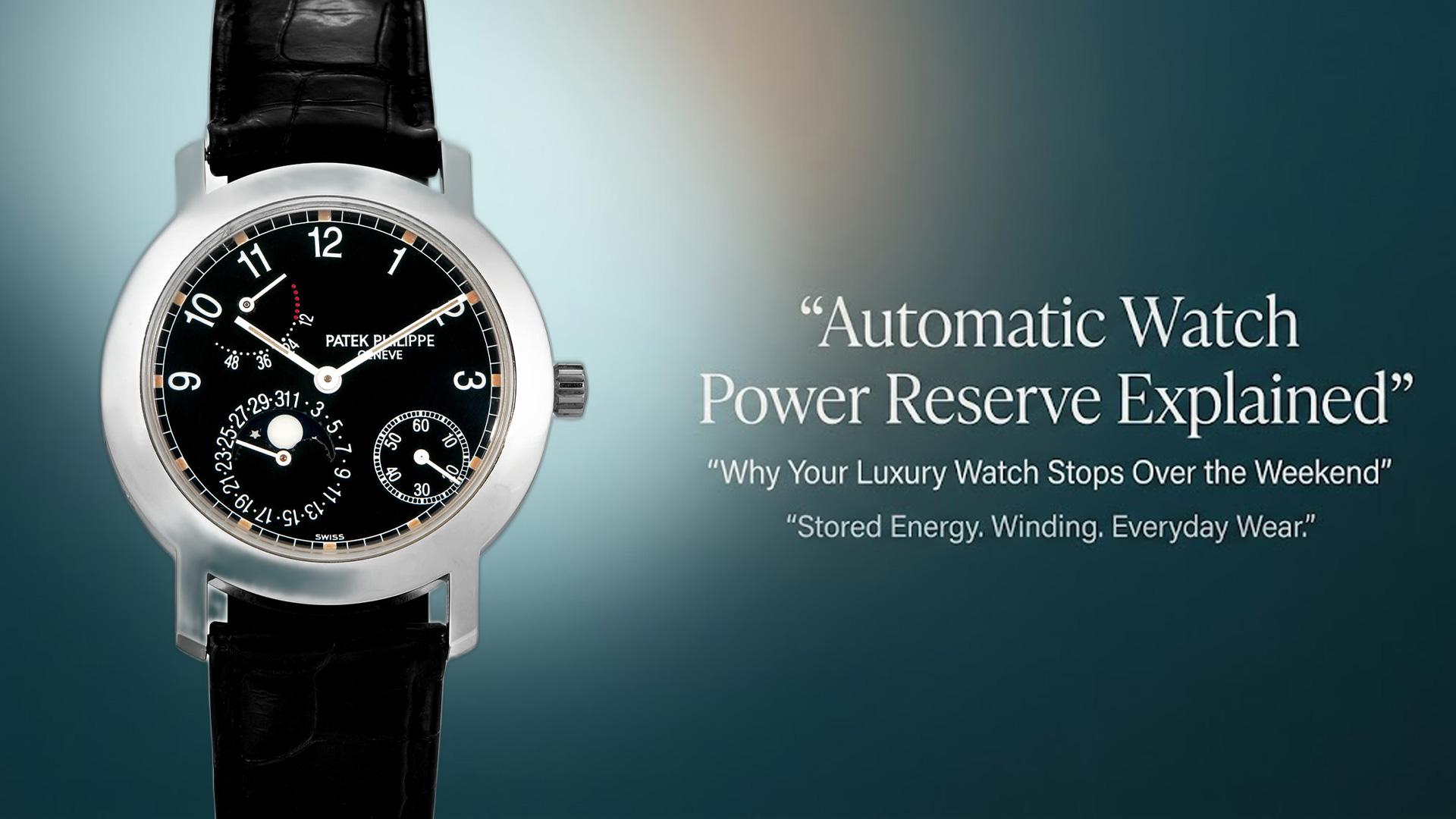
Your Watch Was Running Perfectly on Friday. By Monday Morning, It Had Stopped. Here’s What’s Actually Happening.
You’ve worn your mechanical watch throughout the week. It has kept time, felt comfortable, and performed exactly as expected.
On Friday evening, you put it in its box. Monday morning arrives, and the hands are no longer moving.
For someone new to mechanical watches, that can be unsettling. Has the movement developed a problem? Does the watch need servicing? Should an automatic timepiece continue running even when nobody is wearing it?
In many cases, nothing is wrong.
The answer involves a fundamental feature of mechanical watchmaking: the automatic watch power reserve.
Understanding how that reserve works can make watch ownership considerably easier, particularly if you rotate between different timepieces or occasionally leave your watch unworn for several days.
What Is Power Reserve in a Mechanical Watch?
A mechanical watch stores energy in a mainspring. As that spring releases its stored energy through the movement, the watch’s regulating mechanism controls the operation of its time display.
The power reserve describes approximately how long a fully wound movement can continue running without receiving additional winding energy.
It’s commonly expressed in hours.
For example, a movement with a stated 70-hour reserve may continue operating for approximately 70 hours after being fully wound, subject to its actual condition and operating circumstances.
This does not mean that every watch with a 70-hour specification will run for precisely the same duration in every situation.
Power-reserve figures are manufacturer specifications, not a guarantee about the performance of an individual pre-owned watch.
How Does an Automatic Watch Wind Itself?
Automatic mechanical watches use a winding mechanism that responds to the movement of the wearer’s wrist.
In many designs, an oscillating weight called a rotor moves as the wearer changes position. The winding system transfers energy to the mainspring.
That is why automatic watches are often described as self-winding.
However, self-winding does not mean unlimited power.
The movement still depends on the energy stored in its mainspring. Once that available energy is exhausted, the watch stops.
If you remove the watch and leave it unworn long enough, stopping is normal.
Why an Automatic Watch Can Stop Sooner Than Expected
One of the most common misunderstandings is assuming that a watch worn for several hours must have reached its full power reserve.
Actual winding depends on the movement’s architecture and the amount and character of the wearer’s activity.
A watch worn during a relatively sedentary day may receive less winding energy than the owner expects.
If the movement was only partially wound when removed, it may stop earlier than the manufacturer’s maximum-reserve specification.
That does not automatically indicate a mechanical fault.
It’s useful to distinguish between a movement that stops because it has exhausted its available energy and one that stops unexpectedly despite appropriate winding.
How Long Should a Luxury Automatic Watch Run?
There is no universal power-reserve figure for every automatic luxury watch.
Different calibres have different designs and specifications, even within one manufacturer’s collection.
Consider three modern Rolex examples.
| Rolex Example | Movement | Approximate Stated Power Reserve |
| Datejust 31, selected modern references | Calibre 2236 | 55 hours |
| Datejust 36, reference 126203 | Calibre 3235 | 70 hours |
| Cosmograph Daytona, reference 126508 | Calibre 4131 | 72 hours |
These figures illustrate why buyers should research the exact reference and movement rather than assuming every automatic Rolex, or every automatic luxury watch, has the same reserve.
Older generations may have different specifications.
For someone comparing pre-owned watches, the power reserve can be a useful ownership consideration, but it should sit alongside comfort, condition, servicing, and the functions that actually matter to the buyer.
The Weekend Test: A Simple Way to Understand Your Watch
You don’t need to take apart a movement or purchase specialized equipment to understand its ordinary behavior.
Start by reading the manufacturer’s winding instructions for your exact model.
Where appropriate, follow those instructions to wind the watch correctly and note the time when you place it aside.
Check it periodically over the following days.
Then compare the observed running duration against what is reasonable for that reference, recognizing that the test is informal.
It is not a substitute for controlled professional power-reserve testing.
What the Test Can Reveal
- Whether the watch continues operating for a reasonable period after correct winding.
- How its operating duration compares with your expectations.
- Whether the movement has stopped after being left unused.
- Whether repeated unexpected stopping merits professional attention.
Do not deliberately force the crown or use unfamiliar winding procedures to complete the test.
The correct crown operation differs between watch models, and some movements require specific precautions.
Does an Automatic Watch Need to Be Worn Every Day?
Not necessarily.
Many automatic watches can be worn regularly, occasionally, or as part of a collection rotation, provided their care and setting instructions are followed.
When an automatic watch stops, the owner can generally restore operation through the appropriate winding and setting process.
The inconvenience depends partly on the watch’s complications.
A simple watch displaying hours and minutes may be relatively straightforward to reset. A complicated calendar watch may require additional steps and special care.
Some collectors therefore prefer to keep certain complicated watches running, while others don’t mind resetting simpler references when necessary.
The best routine depends on the watches being owned, not a universal rule that every automatic movement must run continuously.
Do You Need a Watch Winder?
A watch winder is a device designed to move a compatible automatic watch in a manner intended to maintain winding while it isn’t being worn.
It can be convenient for certain ownership routines, but it is not an automatic requirement for every mechanical watch.
For someone with a straightforward three-hand watch, occasional manual winding and resetting may be perfectly manageable.
For a watch with more involved calendar settings, a compatible winder may offer convenience.
However, winding requirements differ by movement. Rotation direction, winding cycles, and suitability should be established from reliable model-specific guidance.
Do not assume that an arbitrary winder setting is appropriate for every automatic watch.
A watch winder also doesn’t replace servicing or repair. If the watch has a mechanical problem, keeping it in motion will not necessarily solve that problem.
Power Reserve vs Accuracy: They’re Not the Same Thing
A watch’s power reserve describes its ability to keep running without additional energy.
Accuracy describes how closely it keeps time compared with an appropriate reference.
The two characteristics are related to the operation of the movement but are not interchangeable measurements.
A watch may have a substantial power reserve and still require timing adjustment.
Another watch may keep accurate time while running but stop earlier than expected because of a winding or energy-storage issue.
If a pre-owned watch is performing unusually, a qualified watchmaker can evaluate the movement more meaningfully than an informal home test.
What First-Time Luxury Watch Buyers Should Ask
Before buying an automatic watch, understand the mechanical experience that comes with ownership.
Five questions can make the buying decision considerably clearer:
- What is the exact movement calibre?
- What power reserve does the manufacturer specify?
- How should this movement be wound and set?
- What is known about the individual watch’s service history?
- Would occasional winding and resetting suit my routine?
A buyer planning to rotate among several watches may place more importance on operating reserve than someone who wears the same reference daily.
There is no single correct preference.
To compare movement types and watch configurations, browse the luxury-watch inventory at Platinum Times Co. USA. The website provides movement filters, although the movement and specifications of any particular listing should be confirmed before purchase.
When Should You Ask a Watchmaker for Help?
An automatic watch stopping after an extended period of inactivity is not, by itself, evidence of a problem.
But certain symptoms justify attention.
These include repeated stopping despite appropriate winding, unusual timekeeping behavior, difficulty operating the crown, or a noticeable change from the watch’s previous performance.
Do not attempt to diagnose internal movement problems by repeatedly operating mechanisms in ways the manufacturer does not recommend.
If a valuable watch is behaving unexpectedly, a professional assessment is the safer route.
Frequently Asked Questions
Why does my automatic watch stop overnight?
It may not have received enough winding energy, or its remaining power reserve may have been low. If unexpected stopping continues despite appropriate winding, seek a professional assessment.
Is a 70-hour power reserve better than 40 hours?
A longer reserve can be more convenient when a watch is left unworn. However, it doesn’t automatically indicate superior quality or make the watch more suitable for every buyer.
Can I damage an automatic watch by leaving it unworn?
Simply allowing a compatible mechanical movement to run down is generally part of normal ownership. Follow the manufacturer’s instructions for storage and maintenance, especially for older or complicated watches.
Does wearing an automatic watch for one hour fully wind it?
Not necessarily. Winding depends on the movement and the wearer’s activity. Follow the manufacturer’s instructions rather than assuming a short period of wear produces a full reserve.
Does a stopped automatic watch need a new battery?
A conventional mechanical automatic movement doesn’t use a battery as its power source. Some other watch technologies differ, so verify the movement type.
Do all Rolex watches have the same power reserve?
No. The stated reserve varies by calibre and generation. Always research the exact reference.
Final Thoughts: A Stopped Watch Isn’t Necessarily a Broken Watch
Understanding automatic watch power reserve removes much of the uncertainty that first-time mechanical watch owners experience.
Your watch stores a finite amount of energy. Wearing or appropriately winding it replenishes that energy, and leaving it unused allows the reserve to run down.
Once you understand the movement’s specific requirements, a stopped watch may simply mean that it’s time to wind and set it again.
The key is knowing what’s normal for your reference and recognizing when something deserves professional attention.
Considering an automatic luxury watch? Compare specific movement generations and ask Platinum Times Co. USA about the exact calibre and condition of a relevant listing before making your decision.

